Continuous gait monitoring is important in Parkinson’s Disease (PD) as gait deteriorates with disease progression and responses to treatment vary over time. Wearable sensor systems offer a practical alternative to laboratory-based gait assessment for real-world monitoring. This study aimed to (1) validate spatiotemporal gait parameters derived from the NUSHU smart shoe system against the Vicon motion capture system in healthy older adults and individuals with PD, and (2) assess whether measurement agreement was maintained during active vibrotactile feedback delivery. Thirty-two participants (17 with mild to moderate PD and 15 age- and gender-matched healthy older adults; mean age 67 ± 7.4 years) completed overground walking trials under no vibration, stance phase vibration, and swing phase vibration conditions. A total of 4790 strides were analysed using linear mixed effects models. Overall agreement was good for stride length (ICC = 0.894, CCC = 0.926), stride time (ICC = 0.853, CCC = 0.954), and velocity (ICC = 0.885, CCC = 0.940), with moderate agreement for double support time (ICC = 0.752, CCC = 0.477). Agreement remained consistent across vibration conditions in both groups.
Rapporter
Vibrotactile Feedback for Gait Rehabilitation
Walking impairments are a major cause of reduced mobility, falls, and loss of independence in individuals with neurological disorders and age-related mobility decline. As the demand for effective rehabilitation continues to grow, there is increasing interest in technologies that can support gait training beyond the clinical setting.
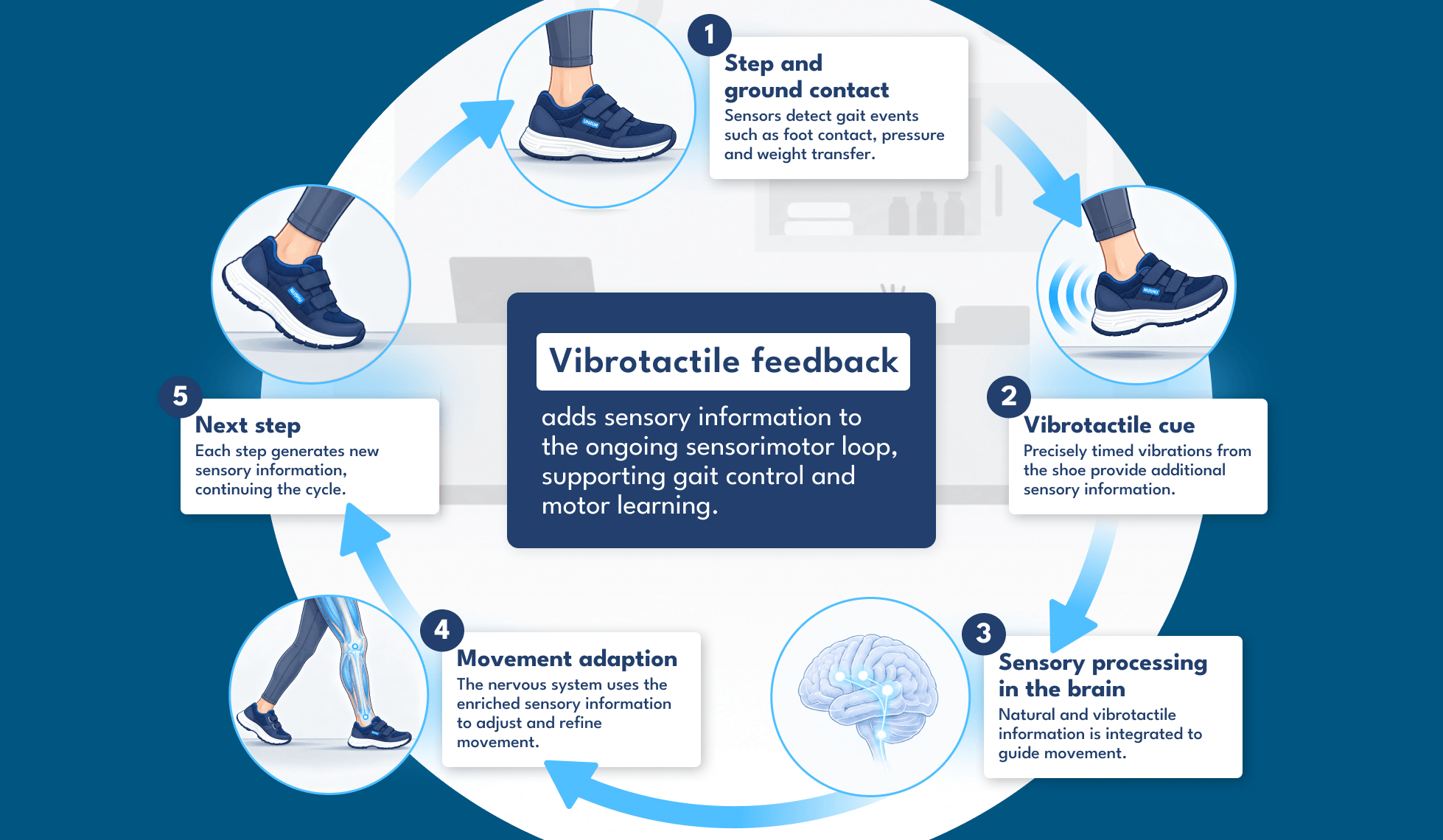
Wearable vibrotactile feedback is one such approach. By delivering precisely timed tactile cues during walking, these systems augment the sensory information available to the nervous system, supporting gait control and motor learning rather than replacing natural movement. A growing body of research demonstrates that vibration can influence proprioception, enhance sensorimotor processing, and improve clinically relevant aspects of gait.
This paper reviews the scientific principles underlying wearable vibrotactile feedback, summarizes the current clinical evidence, and discusses how these findings support the development of wearable rehabilitation technologies for improving gait and functional mobility.
Rapporter
Walking: How the Nervous System Shapes Every Step
Walking is a fundamental part of everyday life, playing an important role in mobility and independence. Although it often feels automatic, each step requires constant coordination between the nervous system, sensory systems and muscles.
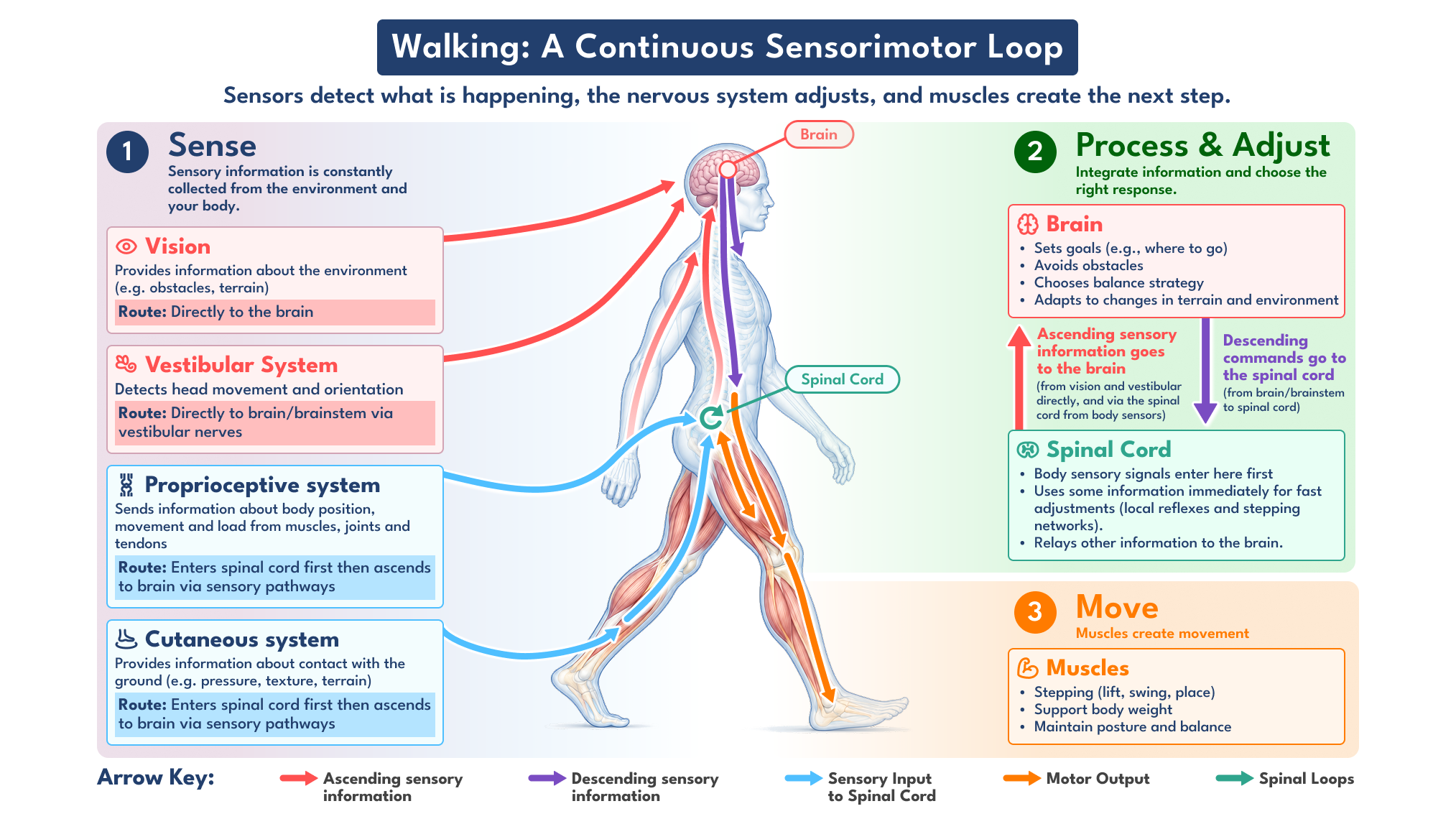
Movement relies on an ongoing sensorimotor loop: the nervous system coordinates movement while receiving continuous sensory feedback from the body and environment to help guide and adapt each step. Changes in gait may result when this communication is affected by neurological injury or disease.
Objective gait measurement can describe characteristics such as walking speed, step length, timing, symmetry and variability. Considering multiple gait parameters and how they change over time can provide a more detailed picture of how a person moves.
Rapporter
From Perception to Movement
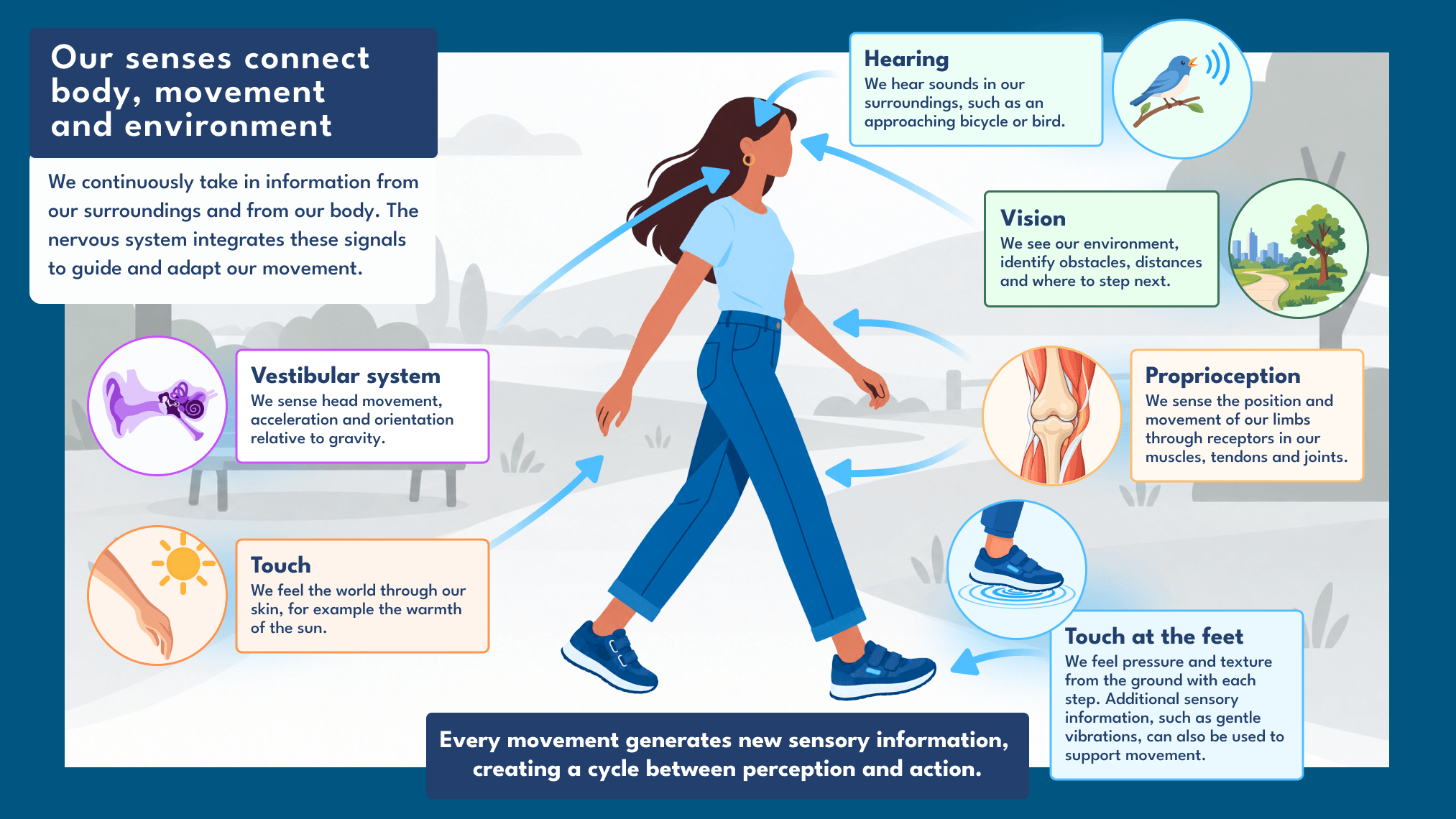
Humans use sensory information continuously to perceive their surroundings, understand the position and movement of their body, and adapt to a changing environment. While sight, hearing, smell, taste, and touch are familiar to most of us, less familiar senses also play an important role in how we move.
Walking is a remarkable example of sensory information working together. Vision provides information about the environment, proprioception about the position and movement of the body, and the vestibular system about movement and orientation. The nervous system continuously integrates this information to guide and adapt movement. Understanding this interaction also introduces the concept of sensory augmentation, in which additional sensory information, such as vibrotactile feedback, can become part of this ongoing exchange.
Rapporter
What Gait Can Tell Us About Fall Risk
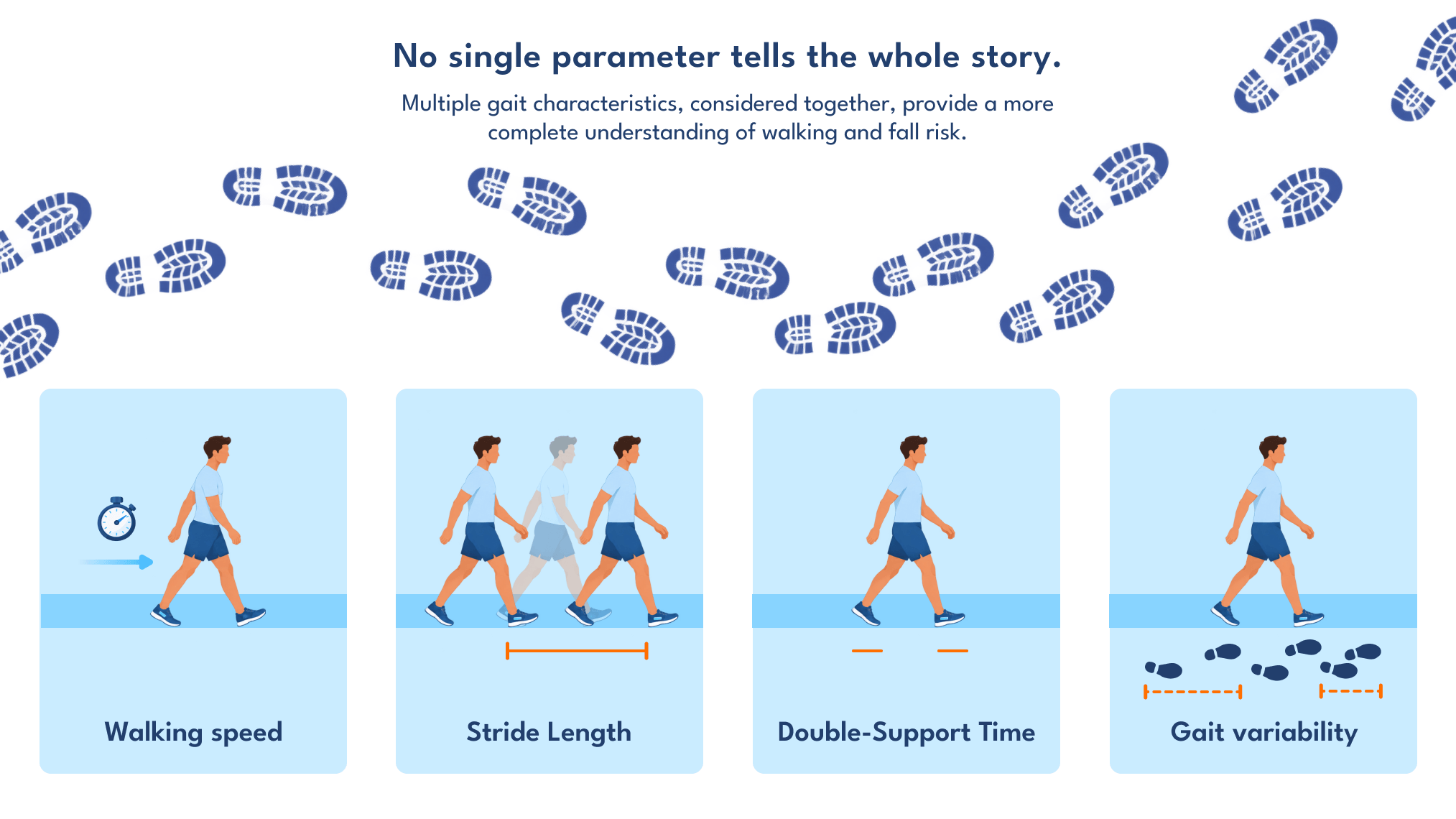
Falls are complex events influenced by many interacting factors. Since walking requires coordination of balance, sensory information, muscle function, attention, and movement, changes in gait can provide measurable data about how a person walks. Research has identified several gait characteristics associated with an increased risk of falling, including slower walking speed, shorter steps and strides, longer double-support time, and greater gait variability.
However, no single gait parameter can determine whether someone will fall. Instead, gait measurements provide different pieces of information about walking performance. Considering multiple gait characteristics, documenting how they change over time, and measuring gait during standardized assessments and everyday walking provides a broader picture of how a person moves.
Scafa S, de Seta V, Wang R, Sanchez Lopez P, Sanchez Lopez A, Varescon C, et al. Nat Med 2026;32(8):2815-2830. An adaptive deep brain stimulation strategy that adjusts to activity and improves gait in Parkinson's disease. NUSHU was used to capture gait in this study.
Lopez PS, Wang R, Varescon C, Schaer A, Ergeneman O, Chatzipirpiridis G, et al. 2025 47th Annual International Conference of the IEEE Engineering in Medicine and Biology Society (EMBC):1-5. A wearable platform that maps motor and neural biomarkers of gait dysfunction in people with Parkinson's disease across daily life.
Rörelsefångstsystem är allmänt accepterade som referensstandard för gånganalys och används för validering av andra gånganalyssystem. Hittills har deras tillförlitlighet och begränsningar vid manuell märkning av gånghändelser inte studerats.
Mål: Utvärdera osäkerhet vid manuell märkning och introducera en hybridmodell för stegdetektering och uppskattning av gånghändelser för autonom, långsiktig och fjärrövervakning.
Metoder: Uppskatta inkonsekvenser mellan märkare genom att beräkna överensstämmelsegränser. Utveckla en hybridmodell baserad på dynamisk tidsförvrängning och konvolutionella neurala nätverk för att identifiera giltiga steg och eliminera icke-stegdata i tröghetsmätningsdata (gång) som samlats in av en bärbar enhet. Slutligen detektera gånghändelser inom ett giltigt stegområde.
Wu J, Becsek B, Schaer A, Maurenbrecher H, Chatzipirpiridis G, Ergeneman O, et al. IEEE J Biomed Health Inform 2023;27(3):1295-1306. Gait phase detection that runs in real time on the wearable itself, validated on free-living gait outside the laboratory.
Kollegialt granskad forskning
Publikationer
NUSHUs teknologi bygger på rigorös vetenskaplig forskning och klinisk validering. Vi samarbetar med ledande forskningsinstitutioner och vårdpersonal över hela världen för att främja förståelsen av mänsklig rörelse och förbättra mobilitetsresultat.
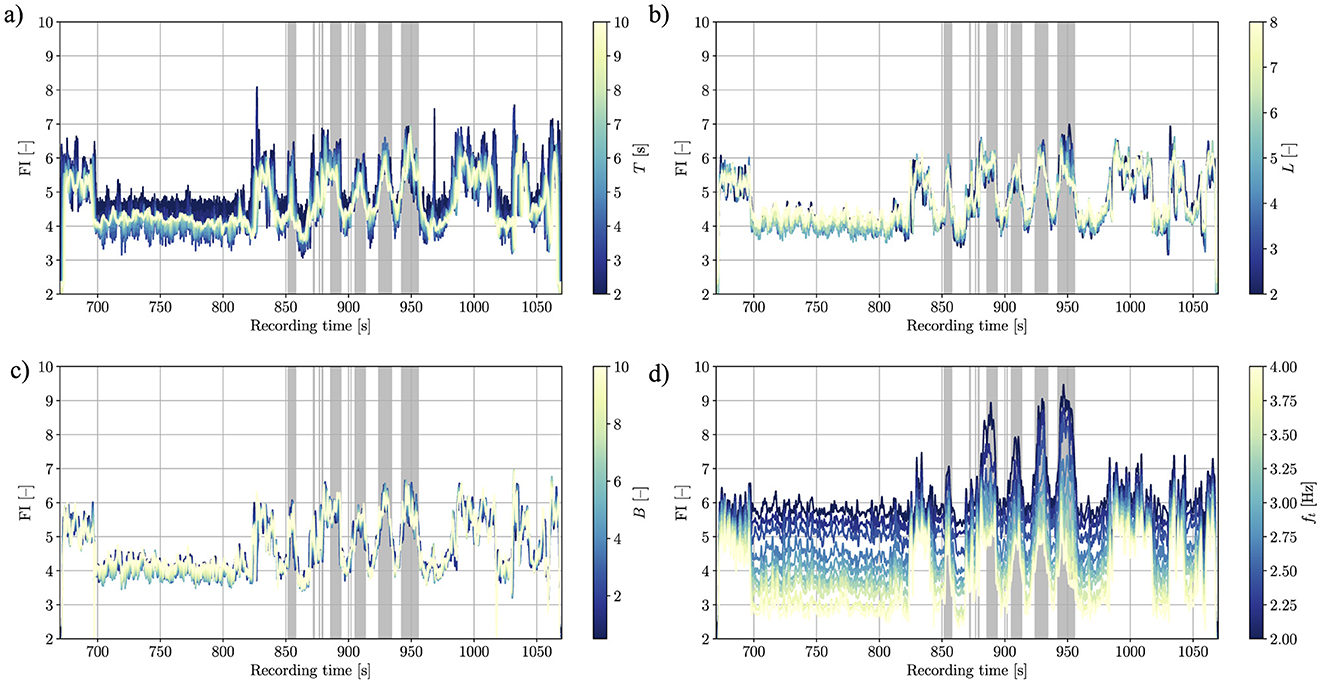
Automatiska metoder för att detektera FOG med hjälp av frysningsindex (FI) har i stor utsträckning föreslagits för att systematiskt övervaka FOG i verkliga livet och vägleda terapioptimering. Metoder för att uppskatta FI har emellertid förlitat sig på ett brett spektrum av mätteknologier och beräkningsmetoder, ofta utan matematisk stringens. Denna brist på standardisering har allvarligt hindrat FI:s acceptans av regulatoriska myndigheter som ett reproducerbart, robust, effektivt och säkert mått att basera vidare utveckling på. I denna studie formaliserar vi definitionen av FI och föreslår en rigorös, explicit uppskattningsalgoritm som kan fungera som en standard för framtida tillämpningar. Denna standardisering ger ett konsekvent och tillförlitligt riktmärke.
Försämring av gången kan användas som en biomarkör för åldrande och neurologiska sjukdomar.
Kontinuerlig gångövervakning och analys är avgörande för tidig upptäckt av brister och personlig reha-
bilitering. Användningen av mobila och bärbara tröghetsensorsystem för gångövervakning och analys har
utforskats väl med lovande resultat i litteraturen. I detta arbete utvecklade vi ett
tröghetssensorbaserat gånganalyssystem i skon för realtidsövervakning av gång och undersökte den
optimala samplingsfrekvensen för att fånga all information om gångmönster. En explorativ validerings-
studie utfördes med hjälp av ett optiskt rörelsefångstsystem på fyra friska vuxna försökspersoner.
White Papers
Vi kommer snart att lägga till en samling av våra white papers.